3 hidden values of bird bath observation with children: Children understand things faster than adults.
bird bathing and parent-child interaction.
Bird baths are not only ecological facilities that attract birds to the garden but also an important medium for children to explore nature and develop their observation skills. Unlike adults, children are often able to discover behavioral patterns, ecological laws, and subtle interactions among birds more quickly than adults. Bird baths provide a safe, fixed, and easy-to-observe focal point, allowing children to receive nature education and scientific enlightenment right at their doorstep.
Most families, when setting up a bird bath, only consider attracting birds, neglecting the observational experience and parent-child interaction value for children. Children are sensitive to details and can quickly capture birds’ movements, changes in feather color, and drinking and preening behaviors, as well as the social behaviors of different birds around the bird bath. This observation not only enhances children’s concentration but also provides rich material for parent-child discussions, stimulating their spirit of exploration and curiosity.
Value 1: Cultivating children’s observation and concentration skills
Birds exhibit a wide variety of bird bathing behaviors, requiring children to pay close attention to their movements, interactions, and environmental changes. The different drinking postures, feather preening methods, foraging behaviors, and wary movements of various birds all provide valuable learning material for children. Through long-term observation, children can cultivate patience and meticulous observation skills—core qualities often lacking in children in modern life.
Compared to adults, children are less likely to rush to “conclusions” when observing birds; they focus more on details and processes. This natural curiosity allows children to notice subtle changes faster than adults, such as the angle of water splashing when birds are preening, changes in the distribution of feather oils, or the order in which different birds enter the water for a bird bath . This early perceptual ability lays the foundation for future scientific thinking and logical analysis.
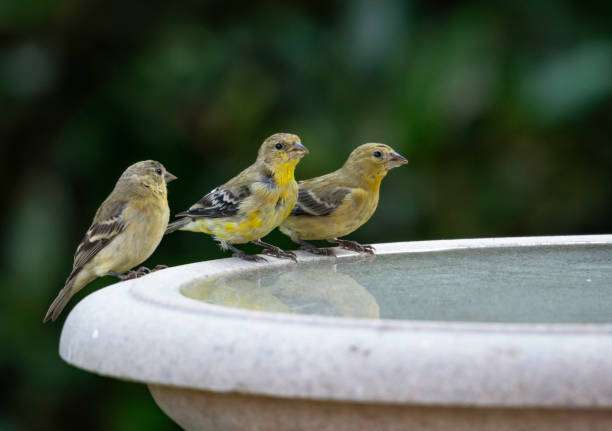
Value Two: Understanding Ecological Relationships and Animal Behavior
Bird baths are a microcosm of the garden’s ecosystem. By observing birds using the water for their bird baths , children can gradually understand ecological relationships, food chains, social behavior, and natural laws. For example, children can observe how large and small birds coordinate their entry into the water for their bird baths , or how certain birds use vegetation as cover to safely drink water. These behavioral patterns are more intuitive and vivid than descriptions in books.
Compared to adults, children’s intuition and perception enable them to quickly discover subtle interactions within the ecosystem. For example, they might first notice a bird waiting for another bird to finish preening before entering the bird bath , or the unspoken understanding among different birds regarding the order in which they use the bird bath . This observation helps children understand behavioral patterns, social interactions, and environmental adaptation strategies among species, fostering ecological thinking and animal behavior awareness from a young age.
Value Three: Enhancing Parent-Child Interaction and Educational Value
Bird baths are not only a tool for children to observe nature, but also an important medium for parent-child interaction. Parents can accompany their children to observe birds, guiding them to describe their behavior, ask questions, and try to explain the phenomena. This interaction not only enhances family relationships but also cultivates children’s expressive abilities, logical thinking, and interest in scientific exploration.
It’s worth noting that children’s observations are often more acute and vivid than adults’. For example, they might notice subtle differences in feather color, individual bird characteristics, or changes in water reflections, details that adults might overlook. Parents can guide children’s thinking by asking questions like, “Why is this bird preening its feathers first? Why is another bird standing nearby observing?” This approach transforms everyday garden observations into engaging science education scenarios.
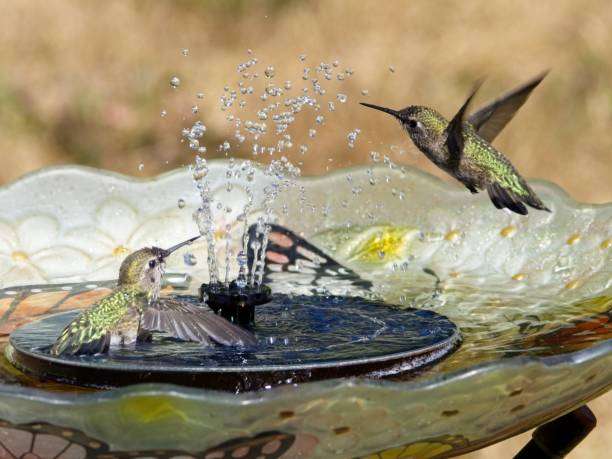
Golden Vision and Children’s Observational Experience
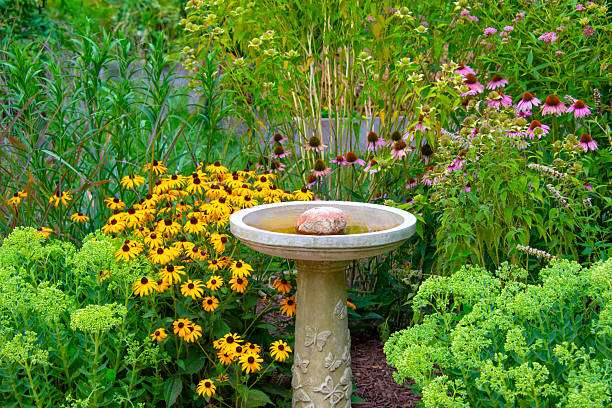
setting up a bird bath , it’s crucial to consider the child’s observation experience. The height, location, and surrounding environment of the bird bath should balance the birds’ safety with the child’s ease of observation. For example, placing it in a semi-open area keeps the birds alert and safe while allowing children to observe from a safe distance without disturbing their behavior. Using a transparent or light-colored bird bath makes surface activities clearer for children, enhancing their observation experience and learning interest.
Furthermore, the layered planting in the garden—with taller plants providing shelter and a sense of security, mid-layer vegetation creating activity pathways, and lower-layer vegetation regulating the microenvironment—allows children to observe how birds utilize their environment and understand the relationship between ecology and behavior. Through observation, children naturally form “ecological maps,” gradually understanding how environmental factors influence animal behavior.
Comprehensive Strategy: Making Bird Baths a Tool for Parent-Child Education
To fully utilize the observational value of bird bathing for parents and children, several strategies can be employed. First, choose a suitable location and height to ensure the birds’ use of the water is safe and natural, while also facilitating observation by children. Second, keep the water in the bird bath clean, of appropriate depth, and with a clear surface to guarantee that children can witness the entire process. Third, arrange plants in a layered and strategically placed manner to provide multiple viewing angles, helping children understand how birds utilize their environment.
Long-term observation also allows children to record bird behavior, create observation diaries, or take photos, transforming daily observations in the garden into scientific experiments and learning materials. This long-term interaction not only cultivates children’s observation skills, concentration, and logical thinking, but also enhances family parent-child relationships and educational value, making bird baths an important part of family ecological education.
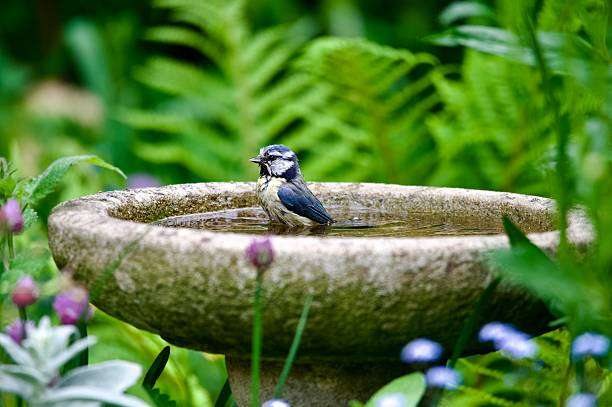
Conclusion: Children’s eyes are more perceptive than ours.
Bird baths are not only ecological facilities for birds but also an important medium for children to explore nature. Children are more likely than adults to notice subtle behaviors, discover ecological patterns, and transform their observations into learning and reflection. By scientifically arranging bird baths, keeping the water clean, optimizing plant layering, and interacting with children, families can create a safe, educational, and fun observation environment in their everyday gardens. Bird baths not only enhance the ecological value of the garden but also become a natural classroom for parent-child education, allowing children to learn, think, and grow through observation.
FAQ
Are children more perceptive when observing birds than adults?
Yes, children pay more attention to details and processes when observing and are more sensitive to subtle changes in behavior and interaction patterns, while adults often only focus on the overall picture or obvious phenomena.
How can you set up a bird bath that’s easier for children to observe?
Choose a semi-open location with a moderately high water level for the bird bath , and layered vegetation around it, while ensuring the birds’ safety and undisturbed natural behavior.
bird bath observation bring to children?
Long-term observation can cultivate children’s concentration, meticulous observation skills, logical thinking, scientific thinking, and expression skills, while also enhancing parent-child interaction and ecological awareness.
Related Posts
5 moments during a bird bath that teach children about the ecological cycle: real and awe-inspiring.
-
Posted by
 Marilyn Everett
Bird bath usage: 3 completely different needs of small birds and large birds
-
Posted by
Marilyn Everett