5 key relationships between bird baths and feather care: Not washing feathers with water equals chronic damage.
Feathers are not merely decorations, but rather a bird’s “life system.”
Many people perceive feathers merely as part of a bird’s appearance, a source of color, pattern, and beauty.
However, from a biological and ecological perspective, feathers are not accessories, but rather one of the core systems upon which birds depend for survival. For birds, the significance of feathers far surpasses that of human skin or fur.
Feathers are directly involved in thermoregulation, waterproofing, windproofing, flight efficiency, energy management, and communication.
They serve as insulation, aerodynamic structure, and protective shell. Once feather function declines, birds face stress on multiple aspects of their survival simultaneously.
Because feathers are so important, birds require constant bird bath for maintenance.
Birds cannot change clothes like humans, nor can they completely molt their entire plumage in a short period. The daily condition of their feathers determines a bird’s quality of life each day. And water is an indispensable core element in feather care.
A bird bath may seem like just a small facility providing clean water, but there is a deep, layered relationship between bird baths and feather care.
When water is scarce, feather damage doesn’t appear immediately, but accumulates slowly and continuously, eventually escalating into a real threat to survival.
First layer of relationship: Feather washing is a fundamental behavior for maintaining the integrity of feather structure.
Feathers are not entirely smooth surfaces, but rather composed of complex microstructures.
The rachis, barbs, and barbules are interconnected by tiny hook-like structures, forming a stable yet flexible whole. Once this structure is damaged, the feather will become loose, break, or curl up.
In its natural state, dust, pollen, oily particles in the air, and urban pollutants constantly adhere to the surface of feathers.
These substances interfere with the delicate connections between barbs, causing the feathers to gradually lose their original tight arrangement.
Birds don’t bathe their feathers just to make them “clean and beautiful,” but rather to restore their physical structure.
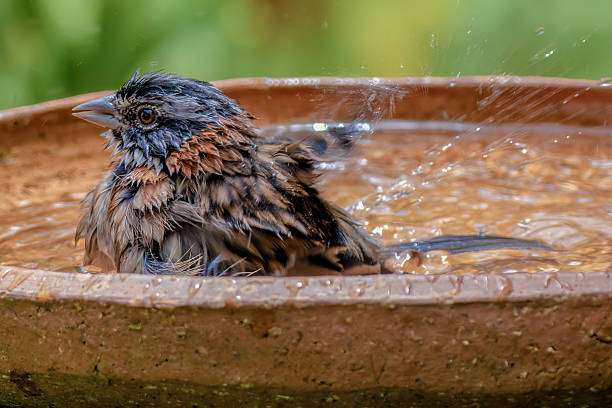
Water dissolves and removes debris, allowing the barbs to realign. When birds bathe, they actively repair their feather alignment through shaking and preening movements.
If bird bath water is lacking for an extended period, the damage to the feather structure cannot be repaired in time.
This damage will not immediately lead to flight failure, but it will gradually reduce the overall performance of the feathers. This is the first stage of chronic damage; it is invisible, yet it has already begun to occur.
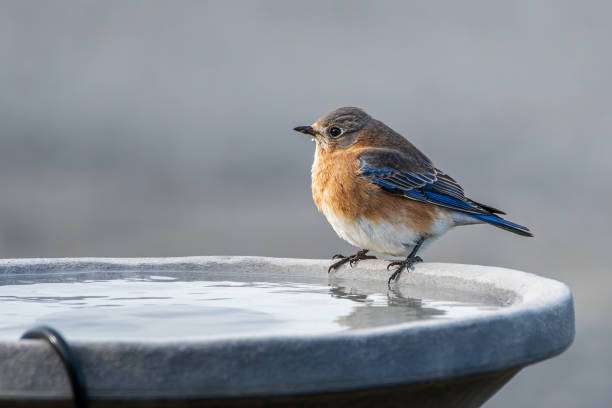
Why is damage to feather structure difficult to detect?
Feather damage is often gradual.
Slight deformation of a single feather will not immediately affect flight or thermoregulation. However, when a large number of feathers are in a suboptimal state simultaneously, overall performance will decline significantly.
Birds have limited perception of such changes.
Unlike humans, they cannot rationally judge and realize that their feathers need care; they can only rely on instinct. Bathing is part of this instinct.
Once bathing opportunities decrease, birds do not immediately “know” that they are being injured, but rather suffer the consequences unknowingly.
The second layer of relationship: Water is the key medium for the functional switching of feathers.
Feathers are not structures with a fixed function, but rather an adjustable system.
In cold environments, feathers form an insulating layer by trapping air through their fluffy arrangement; in hot environments, feathers need to be more compact to help dissipate heat.
Water plays a crucial role in this functional switching process.
After bathing, the feathers temporarily lose their insulating properties, allowing body heat to dissipate more easily. Once the ambient temperature drops, the feathers recover their original state through grooming and drying.
If bird baths lack water, the feathers will remain in a “dry and stiff” state for a long time.
In this state, the feathers cannot effectively insulate against heat or dissipate heat efficiently, resulting in a decrease in the body’s ability to regulate temperature.
This effect is particularly pronounced in environments with large temperature differences.
Bird bath that cannot flexibly adjust their feather configuration during the day and at night, unable to do so, need to expend more energy to maintain a stable body temperature. This extra energy expenditure gradually erodes the birds’ survival reserves.
Why long-term energy waste is the core of chronic damage
The danger of chronic injury lies in the fact that it is not directly fatal, but rather it continuously weakens an individual’s ability to recover.
When feather function declines, birds need to compensate for the energy deficit by increasing food intake, reducing activity, or sacrificing vigilance.
These adjustments themselves bring new risks.
- Increasing feeding time means more exposure to predation risks.
- Reducing activity may affect reproductive success.
- Lowering vigilance will increase the probability of accidental injury or death.
for bird baths indirectly triggers a chain reaction at the energy level through feather dysfunction. This is precisely the hidden aspect of the second layer of relationship.
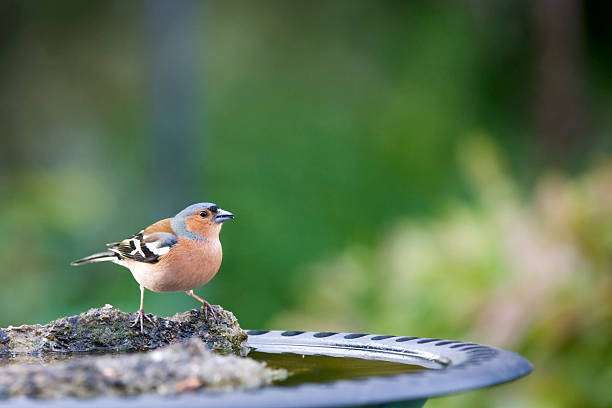
The third layer of relationship: Feather washing is a line of defense against parasites and microorganisms.
Feathers are not only a physical structure but also a potential habitat for microorganisms and parasites.
Lice, mites, and bacteria can all multiply in the gaps between feathers. Without effective cleaning, these organisms can continuously irritate a bird’s skin and the base of its feathers.
The effects of parasites go beyond just discomfort.
The constant irritation forces birds to preen their feathers and shake their bodies frequently. These behaviors themselves increase energy expenditure and generate additional heat in high-temperature environments.
Bathing is an important means for birds to control parasite populations.
Bird baths can wash away some parasites and create conditions for subsequent feather preening. When bird bath water is depleted for a long period, parasite stress will gradually increase.
This stress is not immediately fatal, but it weakens the immune system in the long term, making birds more susceptible to disease. This is the third layer of chronic damage.
How parasitic stress affects overall health
A chronically overloaded immune system reduces its ability to defend against other pathogens.
In urban environments, birds already face multiple pressures, including air pollution, noise, and human disturbance. When parasite problems are added to this burden, their overall health continues to decline.
Bird bathing, by supporting the bathing behavior, actually helps birds maintain a controlled microbial environment.
This seemingly minor effect is decisive on a long-term scale.
The fourth layer of relationship: Feather condition directly affects flight safety and efficiency.
Flight is one of the most important survival skills for birds, and the condition of their feathers determines the quality of their flight.
The tightness of the feather arrangement directly affects lift, drag, and maneuverability.
When feathers become deformed or matted due to lack of bird bathing, flight efficiency decreases.
Birds need to flap their wings more frequently to maintain the same flight distance. This not only increases energy consumption but also reduces reaction time in emergencies.
Even a slight decrease in flight performance can be a matter of life or death when predators are present or when birds need to quickly evade human interference.
Chronic feather damage reduces flight quality, causing birds to lose their advantage at crucial moments.
Bird baths help birds maintain the aerodynamic performance of their feathers by supporting regular feather washing.
This maintenance is not for achieving “perfect flight,” but rather to prevent a continuous decline in performance.
Why is a decline in flight performance not easily detected immediately?
Birds can mask declining flight abilities through behavioral adjustments.
For example, they may reduce long-distance flights or choose safer but less resource-rich areas. These adjustments may seem reasonable in the short term, but they can limit their living space in the long run.
When birds are forced to reduce their activity radius, their ability to cope with environmental changes also decreases.
This passive contraction is a typical manifestation of chronic injury.
Fifth layer of relationship: Feather care influences social behavior and reproductive success
Feather condition not only affects physiological functions but also social interactions.
Many birds use feather condition to convey health information. In the mate selection process, individuals with neat, glossy feathers are often more attractive.
Birds lacking proper bathing facilities may develop dull, ruffled feathers, reducing their competitiveness during the breeding season.
This effect doesn’t necessarily mean they can’t breed at all, but rather it can impact mate quality, breeding frequency, or the investment in raising chicks.
Furthermore, parent birds with poor plumage are more likely to have a lower success rate in raising chicks due to insufficient energy or difficulty in regulating body temperature.
This effect will directly impact the next generation.
From a population perspective, environments that lack conditions for molting over a long period will gradually select for more vulnerable reproductive outcomes.
This is a manifestation of chronic damage at the population scale.
Why is not washing feathers with water equivalent to chronic damage?
Combining these five relationships, we can see that the lack of bird bath water does not kill birds immediately, but it exerts continuous stress on multiple levels, including structure, function, immunity, behavior, and reproduction.
Each layer of stress is not fatal on its own, but they combine to significantly reduce the probability of survival.
Bird baths are not a luxury, but a fundamental part of feather care.
They enable birds to proactively maintain their most important survival tool, thus preventing the accumulation of chronic damage.
Conclusion: The overlooked part of a bird’s feathers determines how far it can fly.
When we talk about bird bathing, we’re not really talking about the water, but the life system behind the feathers. Feather bathing is not a dispensable behavior, but a maintenance mechanism that runs throughout a bird’s life.
for bird baths to wash their feathers is not a temporary inconvenience, but a long-term drain. When bird bath appear in gardens, on balconies, or in urban corners, their role is to prevent this drain from continuing.
FAQ
Do birds really need to molt frequently?
Yes, molting is one of the core behaviors of birds to maintain the structure, function and health of their feathers, and the frequency varies with environmental conditions.
If there is rain in the environment, can it replace a bird bath ?
Rain is sporadic and its intensity is unpredictable, so it cannot replace stable and predictable shallow water bathing conditions.
How long does it take for inadequate feather care to have noticeable effects?
The exact time varies depending on the species and environment, but chronic effects often gradually appear over weeks to months and are difficult to reverse quickly once they worsen.
Related Posts
Bird Bath: 4 Cooling Mechanisms: How Birds Survive Heatwaves
-
Posted by
 Marilyn Everett
3 key functions of a bird bath: How a simple design can save more birds
-
Posted by
Marilyn Everett

Bird baths: An underestimated value – how they quietly improve urban bird survival rates
-
Posted by
Marilyn Everett